

Some songs are tied so closely to a moment that they become part of it. “Three Lions” is one of those rare cases—but with a twist. Instead of fading after Euro ’96, it kept coming back, tournament after tournament, growing into something much bigger than its original release ever suggested.

Written and performed by The Lightning Seeds alongside comedians David Baddiel and Frank Skinner, the 1996 single quickly became the unofficial soundtrack of England football. And over the years, through reissues, re-recordings, and new tournament cycles, it has turned into a living piece of sporting culture rather than a one-off anthem.
Born for Euro ’96—and for England’s emotions
Commissioned ahead of the UEFA Euro 1996 tournament in England, “Three Lions” was designed to do something most football songs avoid: tell the truth.
Instead of blind optimism, it leans into decades of disappointment, missed chances, and emotional bruises that English football fans know all too well. Yet it still carries a sense of hope underneath it all, captured in the now-legendary chorus that feels more like a shared sigh than a victory chant.
That emotional honesty is exactly why it connected so strongly. It wasn’t pretending England would win—it was saying, we know how this usually goes, but we still believe anyway.
The original hit that became bigger than the tournament
When released in 1996, “Three Lions” shot straight to number one in the UK and became inseparable from Euro ’96 itself. But unlike most official tournament songs, it didn’t vanish when the competition ended.
Instead, it lingered in public memory, helped by constant replays, terrace singing, and its ability to capture the feeling of being an England supporter better than any slogan ever could.
The phrase “It’s coming home” also began its long cultural afterlife here, evolving far beyond its original meaning about football returning to its birthplace.
“3 Lions ’98” and the return of hope (and heartbreak)
The story didn’t stop there. In 1998, ahead of the FIFA World Cup in France, the song returned in a reworked version titled “3 Lions ’98.”
This update wasn’t just a remix—it reflected what had happened since Euro ’96, especially England’s painful semi-final loss on penalties to Germany. The newer version leaned into that fresh disappointment while keeping the same core identity intact.
It became a massive hit in its own right, reaching number one in the UK charts and effectively becoming England’s unofficial World Cup anthem once again.
A song that keeps reappearing
What makes “Three Lions” unusual is how often it has come back into circulation. It has been reissued and re-entered the charts multiple times over the years, including further tournament-linked re-releases in 2002 and 2006, when “3 Lions ’98” again returned to public attention during World Cup cycles.
The 2006 version, in particular, packaged both the original and the 1998 recording together, reinforcing how both versions are now treated as part of the same evolving story rather than separate releases.
Even decades later, the song continues to reappear whenever England reach major tournaments, sometimes climbing charts again purely through renewed streaming and downloads. In 2018, during England’s deep World Cup run in Russia, the original 1996 version didn’t just climb the charts—it went all the way back to No. 1. This made “Three Lions” the only song in UK chart history to reach the top spot on four separate occasions with the exact same artist line-up (two separate stints in 1996, one in 1998, and one in 2018).
The song received yet another major update for the 2022 World Cup in Qatar. Because the tournament took place in winter rather than summer, the artists reunited to release a holiday-themed version titled “Three Lions (It’s Coming Home for Christmas).”
A video that feels like shared memory
The music video, directed by Pedro Romhanyi, leaned heavily into a sense of collective experience rather than spectacle. It mixes performance footage of The Lightning Seeds with David Baddiel and Frank Skinner among fans and archival moments that reflect England’s football history.
Rather than presenting football as pure celebration, it acknowledges the full emotional spectrum—joy, frustration, hope, and that familiar sense of “maybe next time.”
It feels less like a promotional video and more like a scrapbook of national sporting memory.
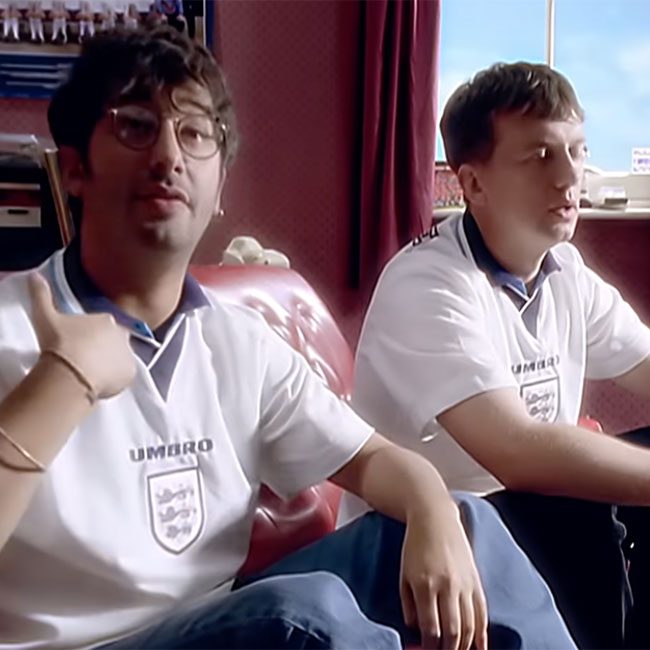
Part of the reason “Three Lions” has lasted so long is that it doesn’t behave like a typical football song. It doesn’t demand victory or promise greatness. Instead, it captures the emotional reality of following a team that rarely makes things easy. And whether it’s the 1996 original, the 1998 update, or any of the later reissues, “Three Lions” always finds its way back—because for fans, the story it tells never really ends.