

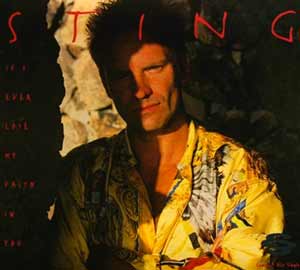
By the time Sting released “If I Ever Lose My Faith in You” on 1 February 1993, he was coming off the emotionally heavy album The Soul Cages. That record had been a cathartic response to his father’s death, and afterward he found himself searching for a new creative direction. This song became the breakthrough he needed—a track he later described as the “flagship” that unlocked the rest of Ten Summoner’s Tales.
Written by Sting and co‑produced with Hugh Padgham, the single introduced a brighter, more playful sound while still carrying the lyrical depth he was known for. It set the tone for an album that was lighter in spirit but no less thoughtful.
 The sound: Sting’s melodic instincts
Musically, the song is built in A major and played in swing time, giving it a buoyant, almost jazzy feel. Sting wrote it on piano, and the intro famously uses a flattened fifth (tritone)—a dissonant interval historically nicknamed “the devil’s chord” because medieval church authorities considered it too unsettling. Sting loved the tension it created, saying it puts the listener “ill at ease” just enough to make the song intriguing from the first seconds.
The arrangement blends pop, rock, and subtle jazz touches, with Sting’s warm vocal sitting comfortably over Padgham’s clean, spacious production.
What the lyrics are really saying
Sting has always been careful not to define the “you” in the title. He’s said that ambiguity is essential—the listener should decide whether “you” is a person, a belief, a spiritual force, or even faith in oneself.
The first half of the song lists the things he’s lost faith in: “Politics, media, science, technology”—all the institutions that once seemed reliable but no longer feel trustworthy. But the chorus flips the perspective. Even if those pillars crumble, there is still one unnamed thing—or person—he cannot afford to lose faith in. That tension between disillusionment and hope is what gives the song its emotional pull.

Release, chart success, and awards
The single became a major international hit. In the United States, it reached No. 17 on the Billboard Hot 100. In Canada, it was even bigger, spending three weeks at No. 1 on the RPM 100 Hit Tracks chart and finishing as the fourth‑most successful single of 1993. The song also reached the UK Top 20, peaking at No. 14 on the Official Singles Chart.
A year later, it earned Sting the Grammy Award for Best Male Pop Vocal Performance, and it was also nominated for Record of the Year and Song of the Year.
“If I Ever Lose My Faith in You” endures because it captures a universal feeling: the world can be chaotic, institutions can fail, but personal faith—whatever form it takes—can still anchor you.
It’s one of Sting’s most balanced songs: musically bright, lyrically introspective, and emotionally open without being sentimental. No surprise it has appeared on every major Sting compilation since its release.